Context
In 2018, Zurich Insurance launched Make the Difference, a program run from its headquarters in Switzerland. The idea was to bring together employees from around the world and make them work together on innovative solutions. Around 30 mid-to-senior executives joined the first cycle, from different backgrounds and experiences, and formed five different teams assigned to corporate challenges, such as speeding up digital transformation, reducing environmental impact or improving employee experience.
They had three months to work on their project and present their proposals directly to the CEO, and the requirement was that they use Design Thinking and Agile methodologies. Beyond the actions and products the program could generate, the deeper goal was cultural: to move a large, business-centric organization toward a more customer-centric mindset.
Each team had every resource it might need, including a dedicated UX design team. That is where I came in. Somehow, a huge stroke of luck gave me the chance to travel to Zurich for this project. I had arrived in Barcelona the year before to become a UX designer, and this was the first job I got hired for. Obviously, at that time I didn't have the experience for a position like that, but I took advantage of all my collaboration soft skills and my designer-developer toolkit not only to survive, but to end up adding real value to the program.
Role and Responsibilities
I was hired by a consultancy company (IAP Solutions) on behalf of Accenture, Zurich's service provider. Over roughly ten months (three cycles), I traveled almost every week to Switzerland to collaborate on the program. The design team was formed with two other UX designers, all sharing the same role and responsibilities.
Even though we were officially hired as "UX Designers," the work was less about producing final UI and more about steering ideas from problem to tested concept. In short, we collaborated on:
- Facilitation: running design thinking and innovation workshops across multiple cycles.
- Ideation and synthesis: framing problems, facilitating ideation, and clustering and prioritizing ideas with the group.
- Prototyping and early validation: turning selected ideas into low-fidelity prototypes to test concepts quickly.
The Process
1. Facilitating the design process
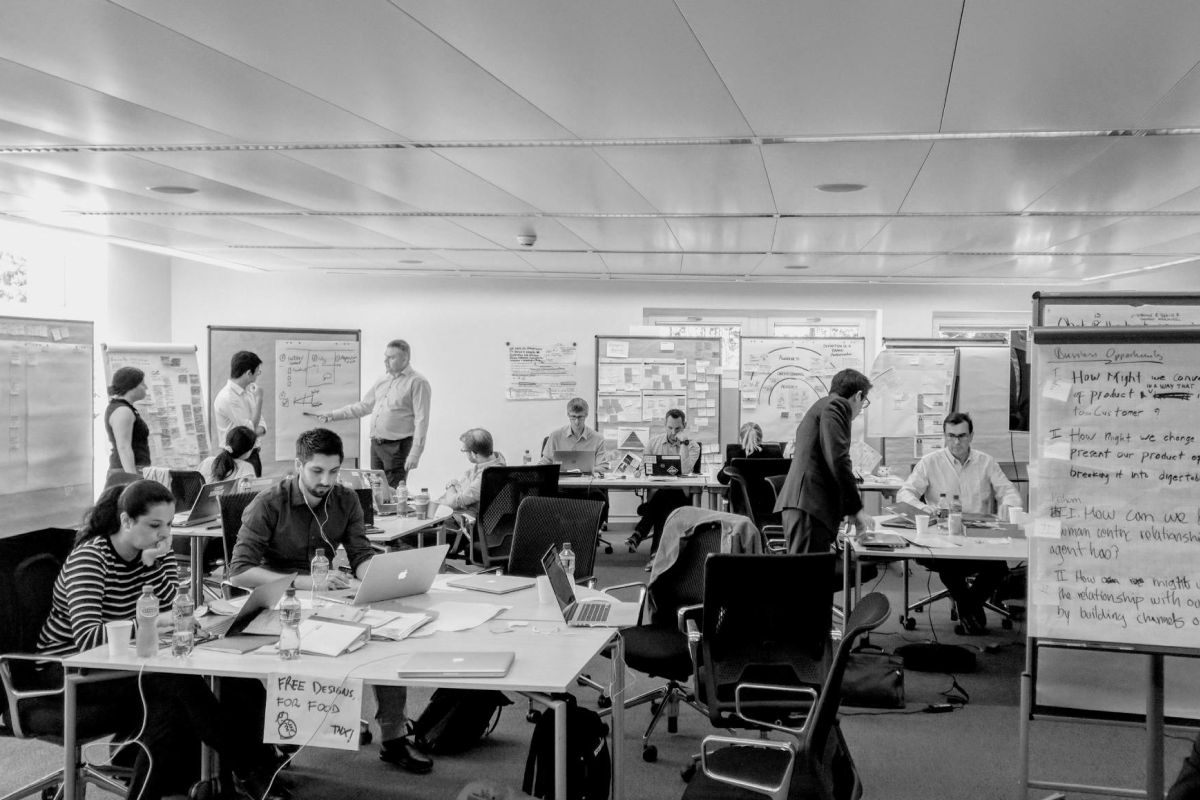
The design team's role was to guide participants, most of them new to design work, through the full Design Thinking process. The early weeks of each cycle were about introducing the methodology and grounding teams in research: trend analysis, and above all interviews and conversations with company stakeholders such as project managers and HR, alongside the participants' own experience.
The main job was to help and support the participants to complete their challenges (they had three months to share their proposals directly to the CEO). All of them had a good attitude and knew the business well, though most were new to design work. Even though they received instruction in Design Thinking theory, process and so on, in the first days and weeks we (the design team) were mostly building confidence and the working relationship, providing small design outputs for them such as presentations and logos.
2. Research and gathering data
A key activity in the Design Thinking approach was to collect as much feedback and information as possible to reframe the problem to handle. The teams ran multiple research activities (interviews, benchmarks, discussions and so on), but we were there to facilitate the download and organization of the information, bringing a little light into a chaos of data.
3. From ideation to definition
Once teams had gathered insight, I led ideation: brainstorming, concept canvases, and personas and user journeys to keep the user at the center. I then helped turn the strongest ideas into early concepts and clickable prototypes that could be tested quickly with real users, iterating until a team reached a validated concept within the tight three-month window.
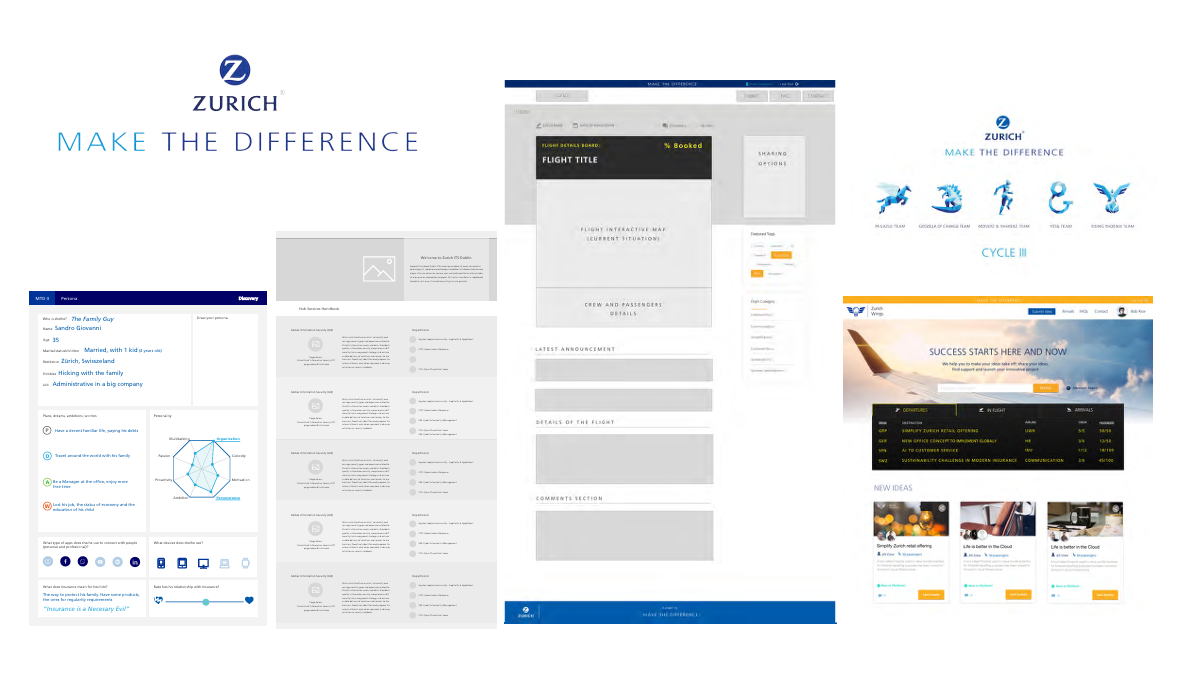
For the ideas that went furthest, the work extended into higher-fidelity design and hand-off to developers. The clearest example was a knowledge-sharing portal, later known as the Zurich Store, where I supported the build of an MVP: delivering design assets, working through Agile sprints with an external development team, and supervising the hand-off with the project manager.
Learnings
Between February and October 2018, almost 90 executives participated in the MTD program in its first three cycles. The output was around 12 to 15 initiatives completed and shared with the corporation's top management. I contributed, in varying capacities, to ten of those initiatives. Most did not pass the prototype stage, which is consistent with the purpose of the program: the aim was less to ship finished products than to validate ideas quickly. A few went further: the Zurich Store knowledge portal reached MVP stage, and several of the concepts we started in these cycles were later taken forward and implemented within the company.
What I took from this experience, early in my career and well outside my comfort zone, is a strong, practical command of facilitation and Design Thinking: how to bring people with no design background into the process, keep the user at the center under time pressure, and use prototypes to move a group from a vague challenge to a concrete, testable idea.