Contributing to the AI Transformation
Cotecna AI-Driven Product Design Organization Initiative
Cotecna ITPI · Initiative owner · In implementation, 2026
The corporate mandate was to apply AI wherever possible to improve the organization's workflows and processes. I translated this command into a complete operating model for AI-Driven product design.
The problem was never tooling. Every design request, from a label change to a multi-screen redesign, went through a single informal queue, so low-value execution crowded out strategic design across a portfolio of 15+ products. Product Managers had stopped raising ideas they knew design would never reach: a bottleneck that kills exploration before it starts. Generic AI tools didn't solve it either, because output that doesn't look like a real Cotecna product is useless for validation.
The model rests on one principle: context is the product. The differentiator isn't the model, it's the context engineered into it.
- A three-tier request triage (Basic, Medium, Complex) that decides who acts and when UX is involved, applied by any PM in under a minute.
- A two-layer context architecture: one global Cotecna design context, plus per-product context kits, governed as living assets with ownership, versioning and regression testing against a fixed prompt set.
- A UX Copilot Agent, built in Microsoft Copilot Studio, that turns a PM request and the loaded context into a coded, browser-openable interactive prototype.
- A portfolio of initiatives grouped by audience: shared foundations, PM enablement, UX acceleration, and design context for development and QA.
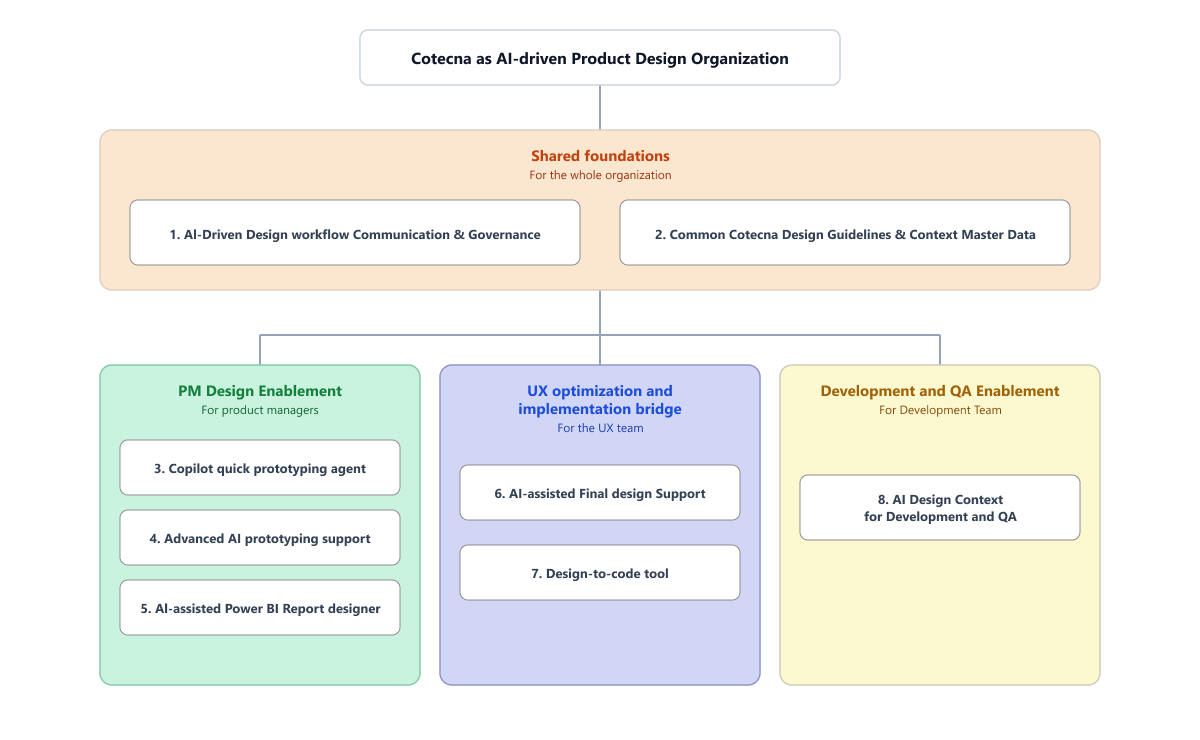
The strategic shift is the point. UX moves from producing every artifact to designing the system (the context, the guardrails, the quality gates) that lets design scale while UX keeps ownership of quality, accessibility and feasibility.
Success isn't measured as UX hours saved. If the model works, the number of ideas explored goes up, because it releases demand that capacity had been suppressing.
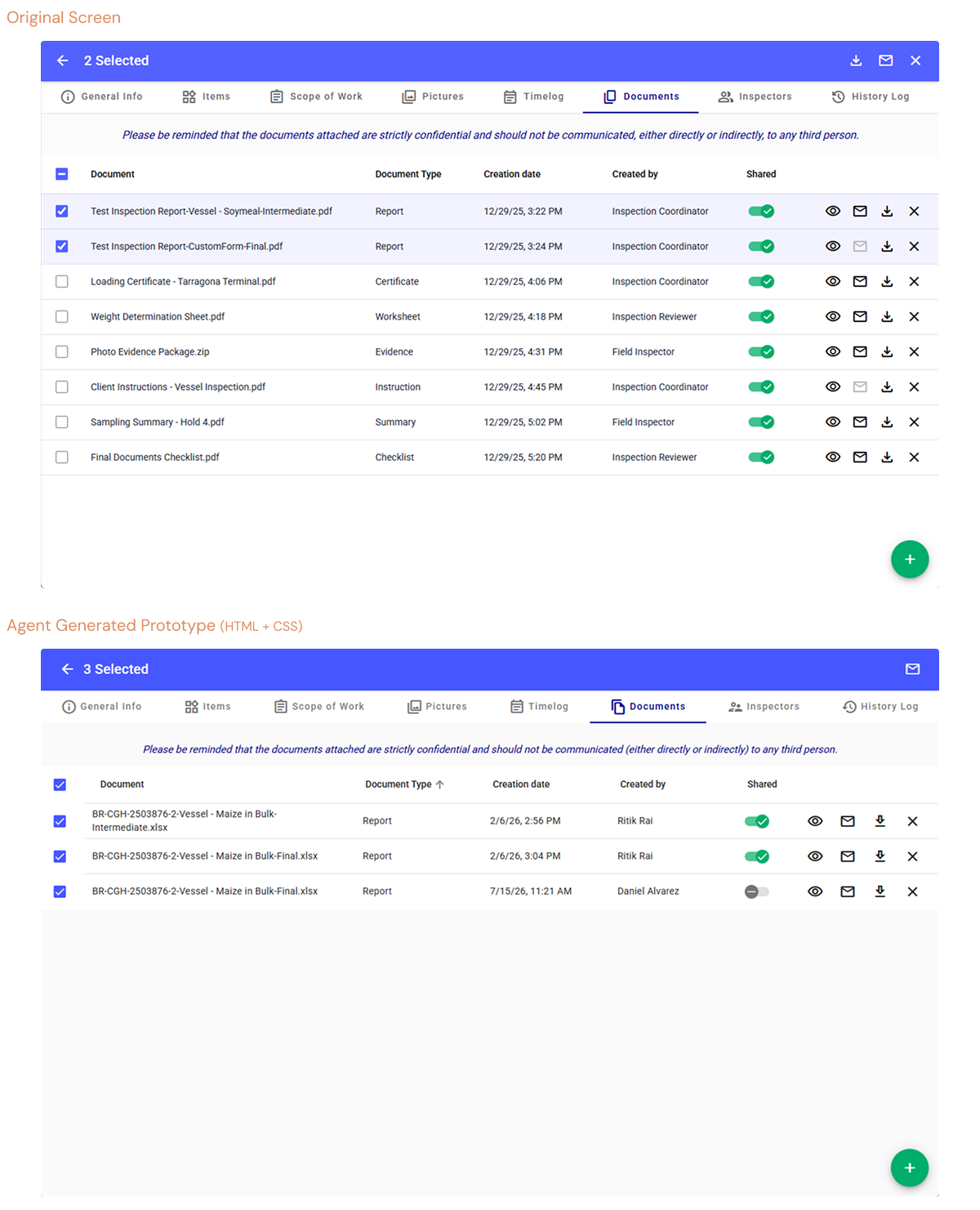
Status: the agent is built and functional. The first pilot, on one of our core inspection products, is in preparation, with the baseline and output-fidelity measurement defined ahead of it.
Designing AI Products
Cotecna Employee internal LLM
Cotecna ITPI · UX/UI designer · In production since 2025 for 5,000+ employees
We created aninternal LLM assistant. It began as a hackathon prototype I designed in 2024 to test whether an LLM could make internal technical documentation easier to reach. It shipped far sooner than planned, for a reason worth stating plainly: employees were already pasting confidential documentation into public AI tools. The product was the containment strategy. It launched in May 2024 and became one of Cotecna's two sanctioned AI tools that October.
Designing it meant solving problems that only exist with non-deterministic systems.
- Two modes, two reliability profiles. The internal LLM answers either from Cotecna's internal documentation or from the open web. Ask an internal question in external mode and the system doesn't fail visibly: it returns a confident, wrong answer. So mode couldn't be a setting confirmed once and forgotten, it had to be an ambient property of the interface. Each mode carries its own color identity, deliberately distinct from the corporate blue, reinforced by disclaimers placed at the moment of risk rather than buried in onboarding. Mode confusion dropped measurably afterwards.
- Designing for first contact with AI. Many of users had no prior exposure to LLM interfaces, in markets where consumer AI tools weren't part of daily working life. Radical simplicity wasn't a stylistic preference, it was the constraint the interface had to be built around.
- Manifest. Alongside the chat, we designed a canvas surface for generating documents and reports, with export to PDF and Excel.
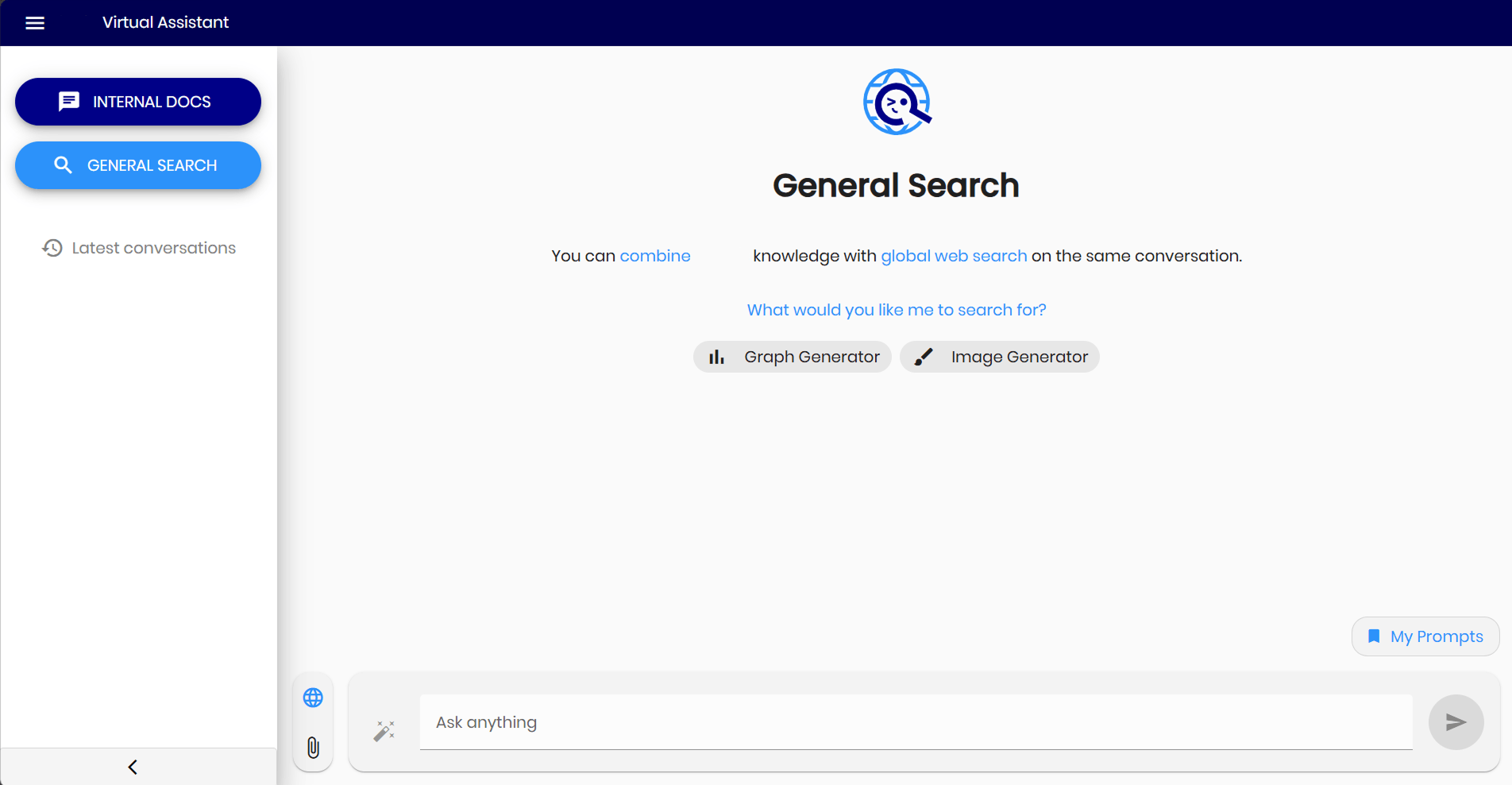
What it taught me. The hard problem was never usability: internal surveys rate the tool very well. It was expectation. Users arrive with mental models formed by consumer AI products that will always iterate faster than an internal tool can, and that gap widened again in 2026 as Copilot licenses spread through the company. Internal AI doesn't only compete on capability, it competes against the interface people used last night at home. Designing for that is a different discipline from designing the chat itself.